


For a decade and counting, USC Bovard College has boosted futures through flexible, practice-driven graduate programs for working professionals.
Ten years ago, USC Bovard College reimagined graduate education by creating online master’s programs built for working professionals and grounded in practice, connection and global reach. At its core was a commitment to access and opportunity: bringing higher education to students who previously could not reach it because of location, work, family, or other professional and personal responsibilities.
Its vision, notes founding Dean Anthony Bailey, “was simply to be the best at providing flexible, innovative online graduate programs designed for people at the busiest times in their lives.”
Bovard College also offered something new at USC — a fully online school, the first of its kind at the university. “We built it differently,” Bailey said. “We assembled a leadership team with strong industry experience in addition to traditional academic backgrounds.”
From the initial cohort of 55 students in its inaugural program — the MS in Human Resource Management (MSHRM) — Bovard College has grown to more than 3,500 alumni, 140 faculty and seven master’s programs. Over the years, Bovard College has expanded to include master’s degrees in project management, criminal justice, hospitality and tourism, emergency management, and library and information science. And the first cohort for the newest offering, the MS in Applied Analytics (MSAA), began classes in January 2026, underscoring the college’s ongoing commitment to interdisciplinary degree paths that are redefining industries.
The college also is home to USC Bovard Scholars, which supports exceptional high school students each year in overcoming financial and other barriers on their path to top universities.
Built for Working Professionals
From the start, Bovard College’s graduate programs have served students balancing careers, families and ambition. The courses are delivered fully online, and the experience is highly engaging. Faculty are industry leaders who teach what they know firsthand, mentoring students one-on-one and bringing real-world relevance to every discussion.
For Calvin Tang, a police lieutenant, hostage negotiator and graduate of the MS in Criminal Justice (MSCJ) program, that mix of perspectives was transformative. “I expected everyone to be in law enforcement, but there were people from defense, social work and other fields,” he said. “Those honest, open discussions changed how I think about policing.”
Tang immediately put his coursework into practice, rebuilding a school resource officer program. “My Bovard classes led not only to success in how we improve public safety but also to national recognition as a model agency,” he said.
The same sense of connection drew Patrick Murphy, whose career spans 25 years at such institutions as the Bronx Zoo, New York Aquarium and Disneyland Resort, where his current role is in revenue management and analytics. Seeking to refresh his skills and expand his network, he enrolled in the MS in Hospitality and Tourism (MSHT), graduating in 2024. Even online, he notes, the classes felt personal. “There’s still a sense of connection,” he said. “USC offers a great network. They really set you up for success.”
Bovard’s international reach impressed him as well, with peers in the program joining classes from as far away as the Middle East.
Such wide-ranging exchanges of ideas are a defining feature of the Bovard College experience. Students come from every professional sector, creating a dynamic mix that mirrors today’s collaborative workplaces.
California Deputy Attorney General Stephen Abanise, who has taught in the criminal justice program since its first year, sees that breadth of experience enrich every class. “We teach students from a diverse set of backgrounds and meet them wherever they are professionally,” said Abanise, a former IRS trial attorney.
“That mix of perspectives makes the learning deeper and more relevant,” he added.
 Graduates gather for commencement at the University Park Campus in Los Angeles. (Photo: Stella Kalinina)
Practice-Based Learning
For Claudia Kropf, who helped design Bovard College’s MSHRM curriculum, the faculty’s connection to practice is what keeps the college ahead of the curve. “We’re preparing people to think critically and act strategically,” she noted. “We listen — to students, to each other, to what’s happening in the field — and we adapt. That’s what keeps our programs and our graduates relevant.”
Having taught at Bovard since its inception, Kropf has seen how the curriculum is continually refreshed to reflect emerging issues such as artificial intelligence, data-driven management and workplace inclusion.
“Some places just record lectures and move on,” she said. “At Bovard, people make themselves available. It’s collaborative, and it’s real.”
Tiffany Danko — a rear admiral and director of the U.S. Coast Guard Reserve who helped design the MS in Emergency Management (MSEM) curriculum — sees that adaptability as essential to the field. “Bovard really works to ensure that our students are getting the best opportunities possible for their professional development,” she said. “We also really strive to make sure that it’s all staying as up to date as possible.”
The college’s responsiveness extends across disciplines. Hicham Jaddoud, inaugural faculty member in the MSHT program and current Bovard College Faculty Council chair, notes how dramatically the industry has changed, with disruption from the pandemic, inflation and recession fears.
“When I started at Bovard, we were teaching traditional management. Now, we’re incorporating technology, consumer behavior and AI forecasting,” he said. “We’re bridging academia and industry so students can see how their learning applies the next day.” He and his fellow faculty also regularly infuse the curriculum with up-to-the-minute insights that equip students to excel in an evolving field.
Abanise added that Bovard College’s approach gives students a wide lens on their careers: “Bovard exposes students to different facets of where their careers could be. It gives skills they can use as researchers or practitioners. It’s a really unique model of excellence.”
Different by Design
In addition to Bovard College’s practice-based focus, it also set out to innovate through its curriculum. Jennifer Baker — an inaugural member of the MS in Project Management (MSPM) faculty and Bovard College’s first Faculty Council chair — had developed project management curricula at other universities and was impressed that Bovard College wanted a more customized program than the standard fare.
“None of the curriculum I had seen at other places included the concept of change management — which is what project management is all about. We actually have courses that are very unique to Bovard,” Baker said, noting that the Project Management Institute — the professional organization that sets standards for the field — has since adapted similar content. “We were ahead of the standard.”
Another differentiator is Bovard’s interdisciplinary focus. Faculty in different degree programs provide peer review of each other’s curriculum, and interdisciplinary workshops are offered each year, ensuring best practices and innovations are shared throughout the college.
 Faculty come together on Zoom to celebrate the Class of 2020. (Photo: USC Bovard College)
Making Connections
Bovard College’s interactive format fosters meaningful collaboration while augmenting professional experience. Virtual classes are small enough for real conversation, and live sessions create a sense of connection that transcends geography.
Christina Olivarria, who earned her master’s in project management in 2019, valued that balance. “It was practical knowledge, not theoretical,” she said. “Our professors were practicing project managers. I could apply what I learned to my work the next day.”
Now vice president of Yellow Brick Consulting, she used her coursework on risk management to create tools for her firm and credits the program with giving her both confidence and credibility. “Having USC on your résumé opens doors,” she said, “but what really matters is that you can do the work — and Bovard makes sure you can.”
Lisa Frazier, a 2019 MSHRM graduate, also saw her career shift. “I wanted to move from administration into a human capital role, and Bovard made that possible,” she explained. One instructor even helped Frazier secure her current job as a consultant for the National Institutes of Health.
Classmates often stay connected, and Olivarria still meets her cohort for USC homecoming each year. “We were a small group, 10 to 15 people per class, and we all became friends,” she said. “I learned a lot from the students as well as the professors.”
Learning Without Borders
For students like Jazmin Thomas, the ability to earn a USC degree without leaving home is life-changing. A New York firefighter and mother of two, she completed her master’s in emergency management in 2024 while working full time.
“The fact that I could do it online made it real,” she said. “Classes were at night after my kids were asleep. It fit my life perfectly.”
Thomas now works for the New York Fire Department’s operations center and has launched PWP Collective, a business focused on emergency preparedness for people with chronic illnesses. She is also developing a nonprofit, MS Empower Resilience, to support others living with multiple sclerosis.
Supportive Mentorship
The Bovard College experience fosters meaningful mentorship between students and faculty. Professors frequently serve as references, advise students on job transitions and connect them to the broader Trojan network.
“Our faculty don’t just teach,” Kropf noted. “They guide. They help students use what they already have, and they stay in touch long after graduation.”
USC’s Bovard Ambassador Program extends that sense of community. Ambassadors — students and alumni who exemplify leadership and service — mentor incoming students and represent the College in professional and public settings.
For Thomas, being an ambassador reflects the program’s emphasis on connection. “You’re joining a community that keeps giving back,” she said.
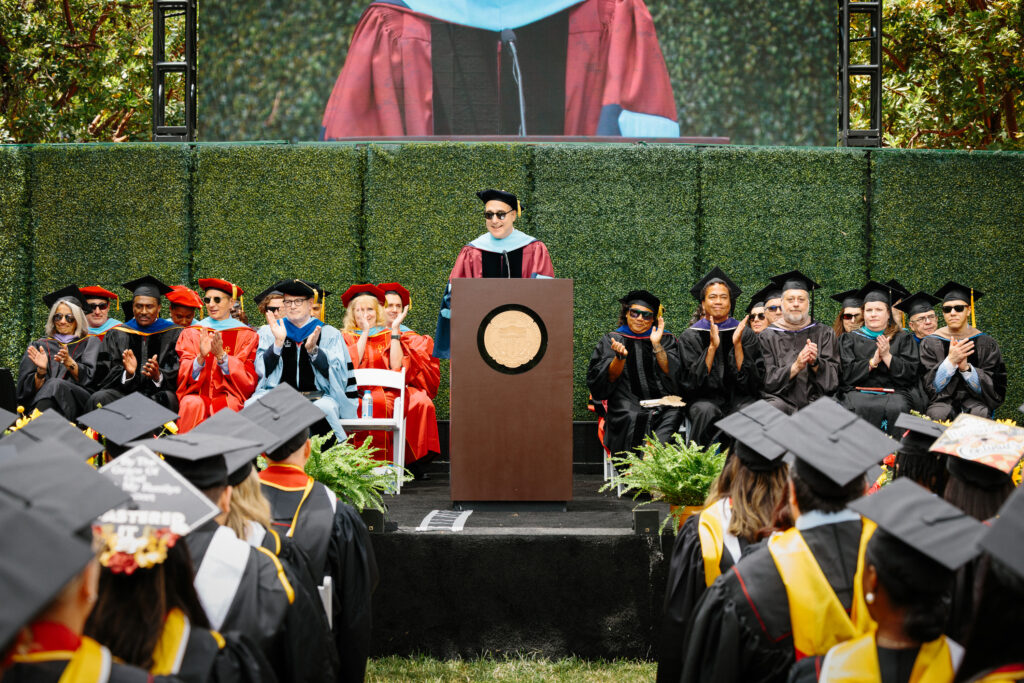 Dean Anthony Bailey addresses graduates at commencement alongside USC Bovard College faculty and leadership. (Photo: Stella Kalinina)
Trojans for Life
Graduates consistently point to networking as one of Bovard College’s greatest assets. Students work together on group projects, connect across industries and tap into the reach of the Trojan Family.
“Meeting professionals across the country helped me understand how different sectors operate,” Olivarria said. “You take that back to your own work, and suddenly you’re seeing things from a whole new angle.”
Jaddoud agrees. “In one class, you might have a hotel manager, a finance analyst and a chef,” he said. “That mix of experience enriches the learning for everyone.”
Growth and Resilience
Since its founding, Bovard College has expanded steadily in size and scope. New programs, new faculty and thousands of graduates add to its growing legacy. Yet its core philosophy remains unchanged: teaching that meets students where they are and prepares them to go further.
Tang sees that impact firsthand. His master’s degree helped him redesign policing programs rooted in research and community needs. “It all started with USC,” he said. “They taught me how to think in an organized way, set goals and build projects that matter.”
Kropf believes that adaptability is central to the college’s evolution. “We’re not just keeping our head above water — we’re swimming ahead,” she said. “We’re giving our fields credibility and our students confidence. That’s something to be proud of.”
Future-Focused
As Bovard College enters its second decade, it continues to evolve — expanding programs, updating curricula and deepening its connections with industry and alumni. What hasn’t changed is its focus on real-world application and human connection.
In classrooms that span time zones and industries, students are learning, debating and building networks that extend far beyond graduation. They’re using what they learn immediately and carrying the Trojan spirit into their workplaces and communities.
For Danko, the future is bright. “I see the results in our students and in what they’re doing and how they’re advancing in their careers,” she said. “As a faculty member, it’s been an incredible opportunity to be part of the growth of Bovard and to see how far we’ve come — and to know that we will continue to grow and evolve to serve our students.”
Bailey expects that trajectory to continue. “The future of work and the economy are changing rapidly and dramatically — AI, data science and emerging technologies are transforming every field. The next 10 years will be about continuing to meet career opportunity head-on, ensuring our students and alumni are always ready to shape the future of their industries.”
Explore online graduate programs at USC Bovard College today.